


AI is accelerating at a pace most organizations are struggling to keep up with. New models are released constantly. Capabilities improve in months instead of years. Features that once felt experimental are quickly becoming standard. From the outside, it can feel chaotic. From the inside, there is a clear pattern driving it.
What we are seeing right now is an arms race. Understanding why big tech is moving so fast is critical, because it directly impacts how organizations adopt, secure, and rely on AI.
Why AI Is Advancing So Quickly
There is no single reason behind the rapid pace of AI development. It is the result of several forces happening at the same time, each reinforcing the others.
1. AI Is Helping Build AI
One of the most important accelerators is that AI is now being used to improve itself.
Tasks like coding, testing, and iteration are highly structured and repetitive. These are exactly the types of tasks AI handles well. What once took developers days or weeks can now be completed in minutes or seconds.
This creates a feedback loop:
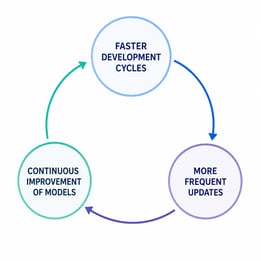
Each version becomes slightly more capable, which allows the next version to be built even faster.
The result is compounding acceleration.
2. Competition Is Relentless
Ryan Spelman, Managing Director of K logix's consulting team, explains, “The major AI providers are not operating in isolation. They are competing directly with one another which creates a constant cycle of one-upmanship. Falling behind, even briefly, can impact perception, adoption, and long-term positioning.”
This pressure is driving constant iteration across the industry. In this environment, slowing down is not an option.
3. It Is a Winner-Take-All Market
Unlike many technology markets, AI is being treated as a space where only a few players will dominate.
The underlying belief among major providers is simple. The company that builds the most capable and widely adopted AI platform will capture the majority of the value.
This creates enormous pressure to win.
It is not just about building a good product. It is about building the best product and doing it before competitors do. That mindset drives aggressive timelines, rapid releases, and constant iteration.
4. Financial Pressure Is Driving Speed
AI is just as much of a financial race as it is a technological one.
The valuations of these companies are closely tied to how their AI capabilities are perceived in the market. When a model performs well or introduces meaningful innovation, valuations can increase significantly. When it falls short, the opposite happens.
That pressure translates directly into development urgency.
Companies are expected to:
- Deliver continuous improvements
- Demonstrate real-world value
- Stay ahead of competitors
This expectation leaves little room for slow, cautious progress.
5. Switching Between Platforms Is Easier Than Ever
Another factor accelerating the race is how easy it has become to switch between AI providers.
Organizations are no longer locked into a single platform.
Ryan Spelman notes, “Many are actively testing multiple models and choosing based on performance, cost, or specific use cases. This creates a highly competitive environment where loyalty is low. If one platform falls behind, users can quickly move to another.”
That reality creates constant pressure for providers to improve rapidly in order to retain users and stay competitive.
What This Means for Organizations
While big tech is racing ahead, most organizations are still trying to figure out how to adopt AI responsibly.
This creates a gap between innovation and implementation.
The Pace of Change Is Outrunning Internal Readiness
Many organizations are still in early stages of adoption, focusing on basic use cases like research, documentation, and productivity.
At the same time, AI capabilities are advancing toward automation, decision-making, and multi-step workflows.
This mismatch creates tension. Organizations feel pressure to move faster, even if they are not fully prepared.
Risk Is Increasing Alongside Capability
As AI becomes more powerful, the risks become more significant.
Earlier use cases focused on generating content or summarizing information. Now, AI systems can take action across systems, access sensitive data, and influence business processes.
This introduces new concerns:
- Data exposure through prompts and integrations
- Over-permissioned AI systems
- Lack of visibility into AI-driven actions
- Increased reliance on outputs that may not always be accurate
The faster AI evolves, the harder it becomes for organizations to keep controls aligned.
Discomfort Among Security Leaders Is Growing
Across industries, there is a consistent theme among security and technology leaders.
They recognize the value of AI, but they are uncomfortable with how quickly it is moving.
This discomfort comes from several factors:
- Limited understanding of how AI systems behave
- Uncertainty around long-term risks
- Pressure to adopt before controls are fully defined
It is not resistance to AI. It is concern about adopting it without the right safeguards in place.
Over-Reliance Is Becoming a Real Risk
As organizations integrate AI into daily workflows, they begin to depend on it.
When AI tools are unavailable or fail, productivity can drop significantly. Teams that rely heavily on AI may struggle to revert to previous processes.
This creates a new kind of operational risk.
How to Respond Without Falling Behind
Organizations do not need to match the pace of big tech. Trying to do so often creates more risk than value.
Instead, the focus should be on alignment.
-
Understand Your Current State: Not every organization needs to adopt advanced AI capabilities immediately. Start by identifying where you are today and what problems you are trying to solve.
-
Prioritize Control Over Speed: Adopting AI quickly without visibility and governance can create long-term challenges. It is more effective to build the right controls early and scale from there.
-
Expect Continuous Change: AI is not a one-time investment. It is an evolving capability that will require ongoing adjustments, updates, and oversight. Planning for change is more important than trying to predict it.
Final Thought: The Race Is Not Yours to Win
Big tech is in a race to build the most powerful AI systems. Your organization is not. The goal is not to move as fast as possible. The goal is to adopt AI in a way that is secure, aligned, and sustainable.
Subscribe
Stay up to date with cyber security trends and more