

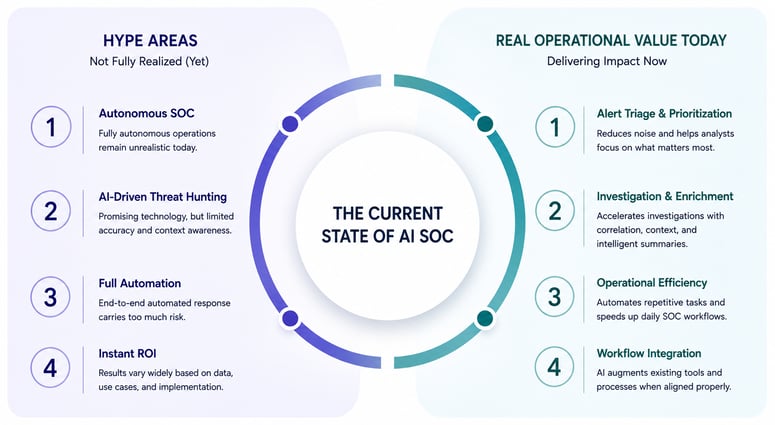
To better understand how organizations are approaching AI-driven Security Operations, we spoke with Brian Rosmus, a member of the K logix Cyber Research team. As part of ongoing research initiatives, Brian and the team recently evaluated a range of AI SOC platforms using a vendor-agnostic, data-driven methodology to understand how these technologies stack up from a features and functionality perspective.
Why AI SOC Is Gaining Momentum
Security teams continue to face familiar challenges, but at increasing scale. Alert volume remains high. Analysts are under pressure to respond faster. And scaling operations often means adding headcount, which is not always feasible.
AI SOC platforms are emerging as a potential solution. These tools aim to automate alert triage, correlate signals across the environment, and accelerate investigations. In theory, this allows security teams to spend less time on repetitive tasks and more time on higher-value activities like threat hunting and incident response. But the reality is more nuanced.
The Reality: Not All AI SOC Platforms Are the Same
One of the biggest takeaways from the research is the significant variation across platforms. While most solutions claim similar capabilities, such as automated investigations or alert correlation, how they deliver those outcomes differs widely.
Some platforms focus on ease of use and rapid deployment. Others emphasize flexibility and customization. Some introduce advanced automation, while others require more manual tuning and oversight.
“There is no one-size-fits-all approach,” Brian noted. “What works well in one environment may not translate directly to another.” This is especially true in AI-driven platforms, where outcomes depend heavily on the data being ingested, how the system is tuned, and how teams interact with it over time.
AI SOC Is Not Plug-and-Play
A common misconception is that AI SOC platforms can be deployed and immediately take over security operations. In practice, that is not the case.
These platforms require context. They need to learn how an organization operates, what is considered normal behavior, and how to interpret alerts within that environment. Over time, teams must guide the system by providing organizational context, validating outcomes, and adjusting how investigations are handled. Context in AI SOC platforms are facts that can be used in an investigation, but don’t determine outcomes. For example, context could be that a user is approved to use a certain VPN tool, or a person is out on PTO.
Where AI SOC Delivers Value Today
Across the evaluation, a few areas consistently stood out:
- Investigation and Triage: Most platforms are effective at summarizing alerts, correlating related activity, and enriching investigations. This helps reduce manual effort and speed up initial analysis.
- Operational Efficiency: By automating repetitive tasks, AI SOC platforms can reduce alert fatigue and allow analysts to focus on more complex work.
- Workflow Integration: Many solutions integrate into SIEM and Ticketing solutions allowing SOC agents to act as an extension of the team within familiar tools rather than requiring a full workflow overhaul.
Where the Market Is Still Maturing
At the same time, the research highlighted several areas where the technology is still evolving:
- Threat Hunting Capabilities: While AI SOC platforms can support investigations, advanced and automated threat hunting remains somewhat limited across the market.
- Reporting and Metrics: Dashboards and reporting capabilities are often underdeveloped, with limited visibility into performance metrics or how outcomes are calculated.
- Documentation and Maturity: Many vendors in this space are early-stage, which shows in areas like documentation, support models, and overall platform maturity.
Why Evaluation Matters More Than Ever
Because of these differences, evaluating AI SOC platforms is not just about features, it is about alignment. Questions to consider include:
- How does the platform fit within your existing architecture?
- How does it integrate with your data sources and workflows?
- How much tuning and oversight will it require?
- What level of automation are you comfortable enabling?
The answers to these questions will ultimately determine success.
A Rapidly Evolving Space
AI SOC is one of the fastest-moving areas in cybersecurity today. Capabilities are improving quickly. New vendors are entering the market, and existing providers are expanding their offerings. For security teams, this creates both opportunity and complexity.
“There is real value here,” Brian shared. “But organizations need to approach it thoughtfully. The goal is not just to adopt AI, but to apply it in a way that meaningfully improves operations.”
Learn More
To learn more about K logix Cyber Research and how the team evaluates emerging technologies like AI SOC, visit:
https://www.klogixsecurity.com/cyber-research
Subscribe
Stay up to date with cyber security trends and more