

AI adoption is accelerating across every industry. Employees are experimenting with new tools, business leaders are evaluating use cases, and vendors are embedding AI into nearly every product they release.
As adoption grows, many organizations find themselves asking the same question: How do we know if we're ready?
The answer has little to do with how many AI tools have been deployed or how frequently employees use them. An organization can have hundreds of employees using AI every day and still be unprepared. Conversely, an organization with relatively limited AI usage may already have the governance, visibility, and controls needed to scale safely.
True AI readiness is about having the people, processes, and oversight necessary to support AI as it becomes more deeply embedded in the business. Without that foundation, organizations risk moving faster than their ability to manage the technology effectively.
The Hidden Cost of Moving Too Fast
When organizations rush AI adoption without the proper foundation, they often create what could be described as AI debt.
Much like technical debt, AI debt accumulates quietly.
It appears when employees adopt tools without oversight, grows when AI systems are integrated into workflows without clear ownership and expands when organizations deploy new capabilities faster than they can understand or govern them.
Examples include:
- AI tools operating outside approved processes
- Sensitive data being shared without visibility
- AI-generated outputs being trusted without validation
- Agents receiving more access than necessary
- Multiple disconnected AI initiatives across the business
None of these issues may seem significant individually. Over time, however, they create complexity that becomes increasingly difficult to manage. Readiness helps organizations avoid accumulating this debt before it becomes a larger problem.
Five Areas That Define AI Readiness
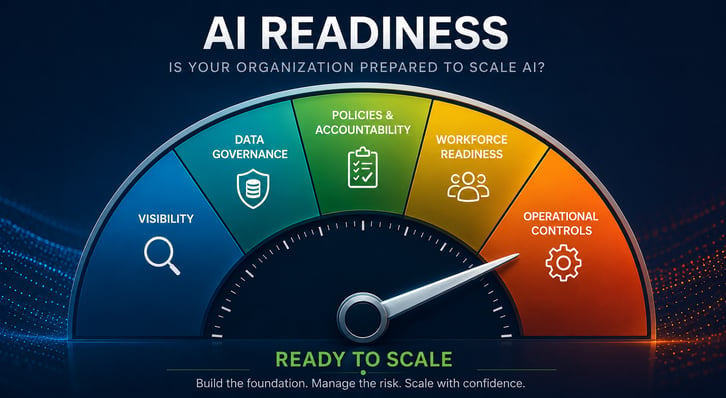
Rather than focusing solely on how AI is being used today, organizations should evaluate whether they are prepared to support AI over the long term. Five areas tend to have the greatest impact.
1. Visibility
Organizations cannot govern what they cannot see. Employees often adopt tools independently, creating a layer of shadow AI that exists outside formal oversight.
Visibility starts with answering basic questions:
- Which AI tools are being used?
- Who is using them?
- What information is being shared?
- What outputs are being generated?
Without visibility, risk becomes difficult to identify and even harder to manage.
2. Data Governance
AI systems are only as trustworthy as the data they can access.
Organizations need to understand what information is being shared with AI systems, where that information is stored, and whether appropriate safeguards exist.
This becomes increasingly important as AI tools gain access to internal documents, customer information, proprietary data, and business processes.
Strong data governance creates confidence that AI systems are operating within appropriate boundaries.
3. Policies and Accountability
Technology alone cannot solve AI governance challenges. Organizations need clear expectations regarding how AI can be used, who owns AI initiatives, and how decisions are made when issues arise.
Without accountability, governance often becomes fragmented. Different teams adopt different approaches, creating inconsistency across the organization.
Successful AI programs establish ownership early and ensure that responsibilities are clearly defined.
4. Workforce Readiness
Employees need to understand both the capabilities and limitations of AI systems. They need guidance on what information should be shared, when outputs should be validated, and where human judgment remains essential.
Even the most sophisticated governance program will struggle if employees do not understand the risks associated with AI usage.
5. Operational Controls
As organizations move beyond AI-assisted tasks and begin adopting agentic AI, readiness takes on a new level of complexity. These systems can interact with applications, access data, execute workflows, and take action across business processes.
Ryan Spelman, Managing Director of Cyber Risk at K logix, explains: "The challenge with agentic AI is that the agentic AI oftentimes has access to pretty much everything that employees have access to themselves."
That access is what makes agentic AI powerful, but it also introduces new risks. Organizations need to understand what permissions AI systems have, what actions they are authorized to perform, and where human oversight is required. Without clear boundaries and monitoring, AI can operate with more access and influence than intended.
Common Signs Your Organization May Not Be Ready
Many organizations discover readiness gaps only after adoption has already begun.
Some of the most common indicators include:
- No inventory of AI tools currently in use
- Limited visibility into prompts and outputs
- Unclear ownership of AI initiatives
- Employees using AI without formal guidance
- AI systems accessing more data than necessary
- Growing pressure to deploy AI without clear business objectives
Readiness Comes Before Scale
AI will continue to evolve. New tools, new models, and new capabilities will emerge at a pace few organizations can fully predict. The organizations that succeed will not necessarily be the first to adopt every new capability but the ones that build a foundation strong enough to support innovation as it scales.
Visibility creates awareness. Governance creates consistency. Control creates confidence.
Together, they create readiness.
Subscribe
Stay up to date with cyber security trends and more