

AI adoption is moving fast. In many organizations, it is moving faster than the systems designed to manage it. Employees are experimenting with new tools. Teams are integrating AI into workflows. In some cases, AI is already taking action across systems. But while adoption accelerates, governance often lags behind and that gap creates risk.
AI governance is not just about compliance or policy. It is about understanding what is happening in your environment and maintaining control as AI becomes more embedded in how work gets done.
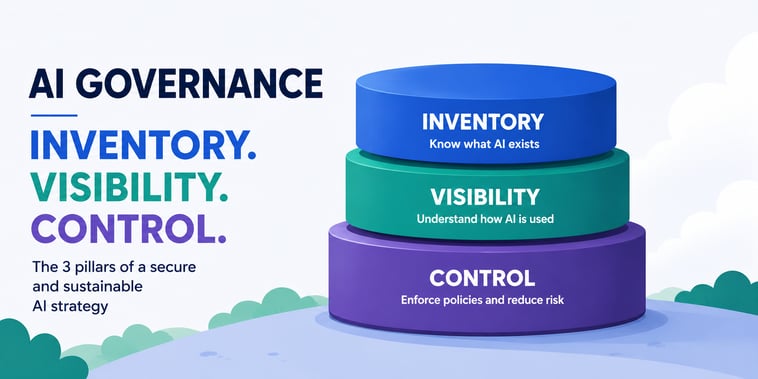
At its core, effective AI governance comes down to three things: inventory, visibility, and control.
Why AI Governance Matters Now
Unlike traditional software, AI systems are dynamic. They generate outputs based on inputs, evolve over time, and in some cases act independently. As a result, organizations face a new set of risks. AI tools may gain access to sensitive information, employees may unknowingly share confidential data through prompts, and AI systems can generate inaccurate or misleading outputs. For organizations experimenting with agentic AI, the challenge becomes even greater, as agents may operate with broader permissions than intended.
Without governance, these risks are difficult to detect and even harder to manage. The goal of AI governance is not to slow adoption but to make adoption sustainable.
Step 1: Inventory Everything
The first step in any AI governance strategy is building a complete inventory of AI across the organization. This includes obvious technologies such as ChatGPT, Copilot, and Gemini, but it also extends to AI-powered features embedded within existing software, internally developed models, automation workflows, and AI agents. Equally important are the data sources these systems rely on, since understanding where AI gets its information is often just as important as understanding the tools themselves.
Many organizations underestimate how much AI is already in use. Employees frequently adopt tools independently, creating a layer of shadow AI that operates outside formal oversight.
A strong inventory should answer four fundamental questions:
-
What AI systems are being used?
-
Where are they deployed?
-
What data do they interact with?
-
Who is using them?
Step 2: Establish Visibility
Once you know what exists, the next step is understanding how it is being used. Visibility is about monitoring interactions between users, AI systems, and data. For generative AI, this means understanding what users are entering into prompts, what outputs are being generated, and whether sensitive data is being shared.
For more advanced use cases, visibility extends beyond prompts and responses. Organizations need to understand what actions AI agents are taking, how they are interacting with systems and APIs, and whether those actions align with intended workflows. Without that visibility, risk becomes invisible.
For example, an employee might unknowingly enter sensitive information into a public AI tool, or an AI agent might access data beyond its intended scope. These issues often go undetected without proper monitoring.
Effective visibility allows organizations to:
- Detect risky behavior in real time
- Identify patterns of misuse or over-reliance
- Understand how AI is actually being used across the business
It turns AI from a black box into something observable.
Step 3: Maintain Control
Inventory and visibility are essential, but they are not enough on their own. Control is what allows organizations to act on what they see. This includes defining and enforcing policies around how AI systems are used and what they are allowed to access.
Key areas of control include:
Data Access
AI systems should only have access to the data they genuinely need. Achieving this requires clear data classification, well-defined permission structures, and alignment between user access and AI access. Without these controls, AI systems can surface sensitive information in ways that were never intended.
Prompt and Output Guardrails
Organizations also need clear boundaries around what information can be shared with AI systems and what outputs are acceptable. Effective guardrails help prevent the exposure of sensitive or regulated data, reduce harmful or inappropriate outputs, and detect attempts to bypass established restrictions. These controls help reduce both accidental and intentional misuse.
Agent Behavior and Permissions
For organizations adopting agentic AI, control becomes even more important. AI agents should be treated much like users: they need clearly defined roles, limited permissions, and ongoing review. Their actions should be monitored and auditable to ensure they operate within intended boundaries.
Governance Processes
Control also requires process, not just technology. Organizations should document AI systems and their intended purpose, review changes to models and workflows, establish accountability for AI use, and ensure alignment with applicable regulatory requirements. Governance is an ongoing discipline that evolves alongside adoption.
Common Challenges in AI Governance
Even with the right framework, organizations face real challenges when implementing AI governance.
-
Lack of integration: Many existing systems were not designed to work with AI, making it difficult to apply consistent controls.
-
Workflow misalignment: AI does not always fit neatly into existing processes, especially when human oversight is still required.
-
Rapid change: AI capabilities evolve quickly, requiring continuous updates to governance strategies.
-
Limited understanding: Employees and even leadership teams may not fully understand how AI systems work or where risks exist. These challenges are common, and they reinforce the need for a structured approach.
Subscribe
Stay up to date with cyber security trends and more