

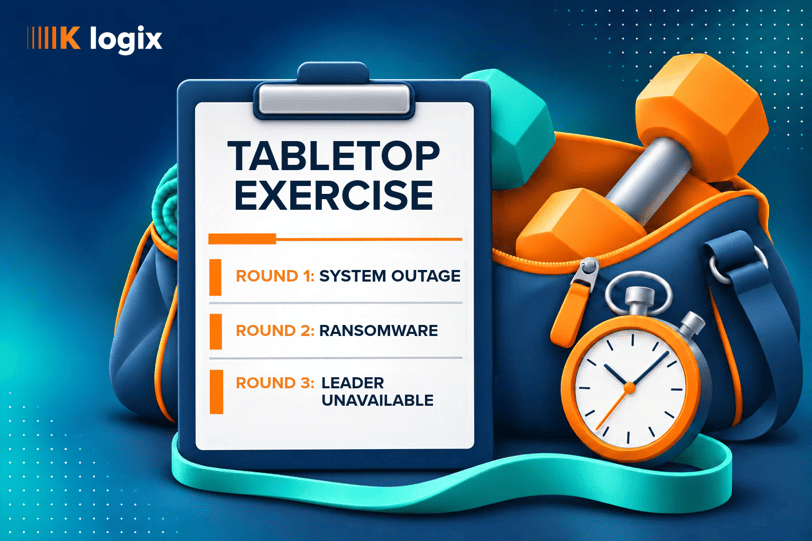
Every organization has an incident response plan. Far fewer know whether that plan works when everything is on fire. A tabletop exercise is how you find out, before a real incident does it for you.
What Is a Tabletop Exercise, and Why Run One?
Think of a tabletop as a penetration test for your organization itself. A pen test probes your systems. A tabletop probes your people, processes, and plans. In a simulated crisis, can your team actually respond? Do they know who to call when an incident hits? Who makes the decisions? What are the communication procedures? Are your plans and policies ready to go, and does the documentation exist where people can find it?
Passing a tabletop doesn't guarantee you'll handle a real incident flawlessly. But it puts you in a far better position to believe you can, and it surfaces the gaps while the stakes are still low.
Why Generic Tabletops Fall Short
Many people picture a tabletop as someone showing up with the same binder they use for every client, flipping to page three, and announcing, "You've got ransomware. Let's deal with it." The team runs through a few questions, everyone feels like they did well, and nobody really learns anything.
That's not a test. It's a rehearsal of what you already know.
What a Great Tabletop Looks Like
A strong tabletop is built around your organization, not a template. It generally unfolds in three phases.
1. Understanding the environment
This isn't a full security assessment. The goal is to understand the shape of your organization: whether you're primarily SaaS or on-prem, how many customers you serve, and who the key stakeholders are.
2. Building a specific scenario
The best scenarios are tied to real concerns, either ones uncovered during research or ones raised directly by your stakeholders. A simple question works wonders: What's the one thing you're worried about? If a stakeholder names something we think can be realistically exploited, it goes straight into the exercise.
That input comes from interviews and conversations. At kickoff, we ask whether there's a specific theme to pursue, such as ransomware or an insider threat. Then, in interviews with the security team, infrastructure team, and others, we ask more targeted questions to find what would be most impactful to test and what security controls already exist around it.
3. Hosting the exercise
This is where the real value happens. A typical tabletop runs six to ten scenes, built around either one really bad day or a really bad series of days. Each scene includes injects, unexpected twists that force the team to adapt. Think of a soap opera where the music changes the moment someone walks into the room: something happened that you didn't see coming, and it could be bad. Now what?
We also prepare for the team to go beyond the script. Behind every scene and inject, we have responses ready for the different directions the team might take. That makes the exercise feel responsive and realistic, and it leaves participants thinking, "This could actually happen, and if it did, it would be really bad."
Exercise for the Organization
As Ryan Spelman, Managing Director of Cyber Risk at K logix, explains:
“If you pushed with physical exercise, you get results. Same thing here. We’re going to push the organization. We’re not going to break them, not going to hurt them. We’re going to push them so that the ability of the organization to respond is improved.”
That is ultimately the goal of a tabletop exercise: not to break the team or embarrass anyone, but to apply stress to the organization enough to expose weaknesses and improve its ability to respond. An outside facilitator really helps here. Many organizations run tabletops internally, and that has value, but an external partner brings a fresh perspective and can challenge assumptions that internal teams may overlook.
When Do You Want a "Painful" Tabletop?
Some clients ask for a deliberately harder exercise. The most painful ones are those where a security leader stays involved in the design but is unreachable during the exercise itself, say, in Fiji with no signal. That lets us build creative scenarios that exploit identified vulnerabilities and test whether the team can function without its leader.
Security leaders typically ask for a tougher exercise when:
- They haven't had a real incident in a while and worry the team is getting complacent.
- The team is relatively new and has never felt the pressure of a live incident.
- They've run the same style of exercise for years and want to shake things up.
A harder tabletop takes more time to craft. It means going deeper into your processes and testing many combinations of controls and variables, so the scenario is challenging without being unreasonably painful and without overlooking easy solutions.
Don't Wait for the Real Thing
Like pen testing, tabletop exercises tend to spike at the end of the year, when teams realize they never got one done. If that's you, there's still time to act. Reach out to talk through your goals and what scenario would be most valuable for your team.
Ready to find out how prepared you really are? Contact us to schedule your tabletop exercise.
Subscribe
Stay up to date with cyber security trends and more