

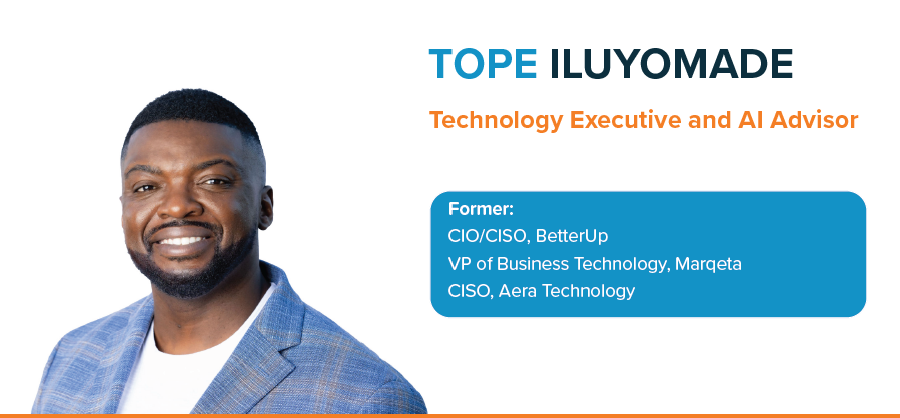
Technology has shaped nearly every part of Tope Iluyomade’s life and career. Long before he became a CIO/CISO and advisor helping organizations navigate AI and cybersecurity, he was a child learning English on a Macintosh computer. “Technology has really helped me personally grow up as a person,” he says. “I learned to speak English on a Macintosh.”
That early fascination with innovation led him into robotics, software engineering, and eventually AI, nearly two decades ago while studying at the University of Maryland Baltimore County. Working on early AI systems in financial services quickly introduced him to the realities of cybersecurity. “When you’re doing early AI and working on Wall Street, naturally cybersecurity came up,” he explains. “How do we secure these systems, especially when hundreds of billions and trillions of dollars would be going through it?”
Throughout his career, Tope has worked across aviation, fintech, supply chain, healthcare, and mental health technology, building a unique perspective that combines technical depth with business leadership. He credits much of his growth to mentors who helped shape how he thinks about leadership and resilience.
One of the defining experiences early in his career came while supporting cyber incident response efforts for organizations connected to the Department of Defense. He says, “We had 24 hours to contain a security breach, redesign the architecture for the company, work with legal, learn policies, and so much more. It was an amazing crash course on cybersecurity when it really mattered.”
That intensity helped build the foundation for how he approaches leadership today: staying calm under pressure by understanding the business impact and focusing on the decisions that matter most.
Learning to Speak the Language of the Business
As Tope progressed into leadership roles, he learned that technical expertise alone was not enough, an important lesson that would stick with him in his career.
After moving from the East Coast to the West Coast and joining Alaska Airlines, he gained his first experience working closely with boards and executive leadership. The shift forced him to rethink how he communicated security.
“To succeed at the executive level, security leaders have to translate technical concepts into business priorities that people understand and engage with,” he says.
That transition did not happen automatically. Tope describes it as a deliberate process of self-awareness and learning from other leaders across the business.
“I noticed that I tended to focus on the technical at first, and there were things I didn’t realize were jargon to nontechnical people, so I had to adjust my self-awareness of how I was sharing information,” he explains.
Rather than staying within the security function, he spent time learning how different teams operated and what mattered to them. “To be successful at this level, you need to be able to put yourself in different perspectives from across the business,” he says. “Sales is trying to make sure revenue’s coming in. The CFO’s trying to make sure profitability is within range or else the business doesn’t exist.”
That mindset fundamentally changed how he approached leadership. Instead of treating security as a separate function, he began framing it in terms of business outcomes and customer trust.
He also credits CFOs with helping him develop that perspective. “The CFOs are the language translators for every function to the board,” he says. “I’ve learned to speak in terms of profitability, and that has really helped me.”
For security leaders looking to move into executive roles, Tope believes relationship building is essential.
“It’s better to get fifty percent of what you want than zero,” he says. “Most security leaders try to translate up to the CFO. That’s backward. Find the analyst on the finance team who builds the board deck and learn their model. By the time you reach the CFO, you’re not translating anymore. You’re already in the conversation.”
Leadership During Crisis
Some of the most formative moments in Tope’s career came during the COVID-19 pandemic while serving at Aera Technology, where the company supported AI-driven supply chain operations for organizations including Unilever, Merck, Pfizer, and Johnson & Johnson.
Before the pandemic, supply chain optimization was important, but during COVID, it became mission critical.
“In March 2020, we rewrote the fulfillment logic from ‘highest-value order first’ to round-robin distribution. The math was trivial. The decision wasn’t. That single change determined which communities got vaccines in the first wave. It’s the moment I realized security and supply chain leadership are the same job in a crisis: deciding who gets protected first, with imperfect information, under time pressure.”
That insight, that crisis leadership is fundamentally a question of triage under uncertainty, became a throughline in how he approached every role that followed.
AI Moves From Experimentation to Accountability
Today, as Tope looks across industries, he sees organizations entering a new phase of AI adoption. He comments that last year the priority was experimentation, and this year the focus has shifted to measurable business value.
“The challenge last year was the bias toward experimentation,” he explains. “The board didn’t want to be left behind. They encouraged teams to experiment with as many AI tools as possible.”
Now, organizations are facing more pressure to justify those investments. “This year, what I’m seeing is the chicken has come home to roost,” he says. “You’ve spent that money, now tell me what it’s done to my P&L impact.”
Tope believes many organizations are struggling to connect AI initiatives to measurable economic outcomes. The excitement around AI remains high, but leaders are now expected to demonstrate tangible results.
His advice is to focus on targeted, high-impact use cases instead of broad experimentation. “Choose a use case that is a very clear about the value, then do it over again and expand,” he says. “This works better than starting with a wide harvesting approach.”
He also sees workforce readiness as one of the biggest gaps facing organizations today. While companies are moving quickly to adopt AI, many are not investing at the same pace in training their employees to use it effectively and responsibly. Tope points out that most organizations still lack the structure and long-term commitment needed to properly develop those skills at scale. For him, successful AI adoption is not just about deploying tools. It requires enabling employees to understand how to use them responsibly and effectively.
Rethinking AI Governance
Tope believes the governance conversation is rapidly evolving. He says that last year, many organizations focused on establishing AI councils and oversight groups. Today, the challenge is operationalizing those efforts in a way that does not slow down the business.
“Fortune 100 companies stood up AI councils to review strategy,” he says. “But this year, what you’re going to see is that CEOs and councils should not be involved in every AI decision.”
Instead, governance must become embedded into day-to-day operations and workflows. “If you have to go through a council or read a document to instrument safeguards, it’s not going to work,” Tope explains. “You need to build in-the-flow-of-work governance for these AI tools to make sense.”
He compares the current state of AI governance to the development of brakes in automobiles. Governance should not exist to slow organizations down. It should exist to make innovation safer and more scalable.
“If you and I didn’t have brakes in cars, we would never go over the speed limit,” he says. “We are able to speed because we trust the safety of the brakes.”
That philosophy extends beyond internal governance and into third-party risk management, procurement, and regulatory oversight. Organizations are increasingly asking where AI is being used and whether vendors are operating within public or private environments.
“What can I use to make sure this tool doesn’t deviate from what we signed up for?” he says. “Last year reactive was fine. This year proactive is necessary.”
Building What Comes Next
Tope is entering a new chapter focused on board advisory work and building a company of his own.
He says, “After a career inside security and technology organizations, I’ve watched most AI investment go to the enterprises that least need help affording it. The gap I’m focused on is the middle market: companies with real operational complexity but without the budget or staff for enterprise AI tooling. That’s where I think the next decade of meaningful AI adoption happens, and where two decades of operating at the intersection of security, infrastructure, and enterprise systems translate most directly.”
That shift is what excites him most. Not just the technology itself, but the opportunity to rethink how systems, people, and organizations interact.
As AI continues to evolve, Tope believes leadership will become even more important. For him, the future belongs to leaders who can balance innovation with accountability and move beyond fear-driven conversations about AI. “The world is going to be rewired around it,” he says. “So I’m making a big pivot in my career to be at the forefront of that and apply it to the right places that matter.”
Subscribe
Stay up to date with cyber security trends and more