

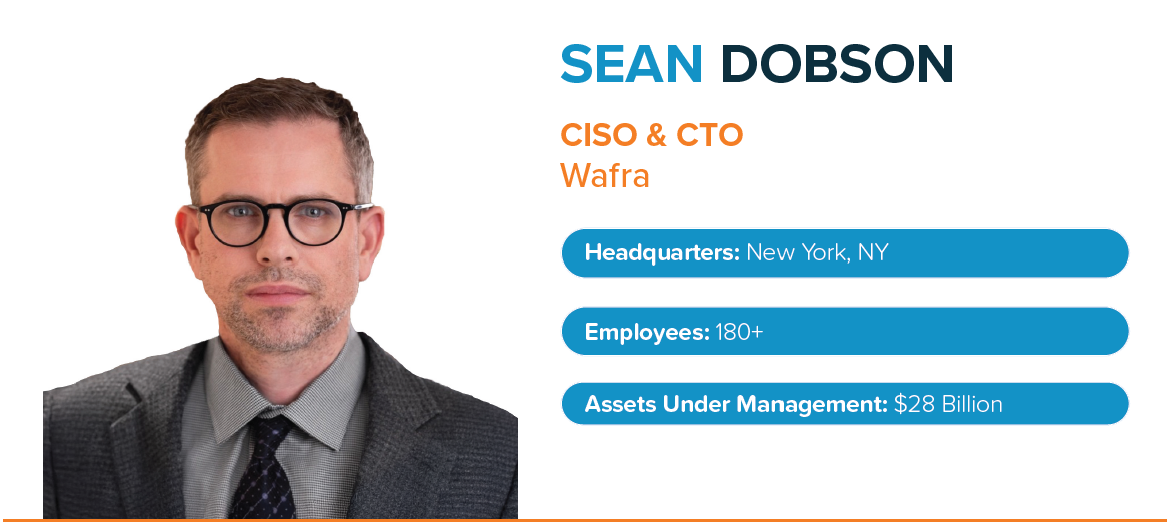
Sean Dobson’s journey to becoming the Chief Information Security Officer and Chief Technology Officer at Wafra is marked by curiosity and a constant drive to learn. His passion for technology began early, sparked by a fascination with how computers worked and a determination to master them. While in college, he led the help desk supporting more than 40,000 students, an experience that offered deep exposure to real-world IT challenges. “I decided I was going to learn everything about computers,” Sean recalls. “That curiosity brought me to studying it in college.”
One of his first jobs was at Merck, one of the world’s largest pharmaceutical companies, which provided a foundation that would shape his technical depth. There, he cycled through numerous roles including web design, Linux administration, storage, and hardware support, earning a reputation as a deeply technical problem solver. Yet while his technical skills flourished, he recognized a gap in his ability to effectively communicate. “My review from that time said I was the most technical person my boss had ever worked with, but that I needed to work on my communication skills.”
Determined to strengthen that skill, Sean pursued a master’s degree from Stevens Institute of Technology. The program, focused on the intersection of business and technology, transformed his perspective. “It wasn’t just about being technical, it was about learning why technology exists in the business,” he explains. It also pushed him out of his comfort zone through presentations and public speaking, helping him overcome what he once described as his “worst fear.”
After earning his degree, Sean joined Accenture, where he expanded his technical foundation through consulting engagements involving data center migrations, networking, and large-scale storage projects. The role exposed him to executive stakeholders and honed his ability to translate complex technology into business value. From there, he transitioned to the finance sector, helping build infrastructure and security programs for hedge funds. “Once I really started to focus on security, that was all I would think about, even when I wasn’t at work. It was during this time I decided to really focus on the security side of things,” he says.
When the hedge fund Sean was working at closed during the 2008 downturn, Sean joined another hedge fund and built their security program becoming the Chief Information Security Officer. That hedge fund eventually closed in 2017 when Sean joined a crypto startup called Digital Asset Custody, where he served as CISO and later CTO. “We built the security program, helped build the product, and eventually sold the company,” he explains. That success led him to his current position at Wafra, where he now leads both technology and cybersecurity as CISO and CTO. “I handle everything including cyber, infrastructure, helpdesk, development, and automation,” Sean says. “It keeps me on my toes. Every day is different.”
Building a Culture of Innovation
At Wafra, Sean has helped establish a strong, top-down security culture, one where every employee is engaged. His next challenge, he says, is extending that mindset to artificial intelligence. “I created our AI working group about two years ago,” he explains. “My biggest focus now is to create an AI culture, pushing AI throughout the organization while making sure it’s done securely.”
Right now, Sean’s three main areas of focus are AI, automation, and data security, which aligns both his technical foundation and his forward-looking leadership. “Around AI, we’re focused on observability and posture management,” he says. “We want to make sure that as AI expands, we can monitor it, understand it, and secure it.” On data security, he sees meaningful progress after years of complexity. “It was always an impossible problem to solve, but now we’re seeing platforms that really help. We can detect if someone tries to upload sensitive data to an AI site, track the context of data across sources, and have a central view into the entire data universe” he notes.
Automation is another key area of focus. “We’ve probably automated hundreds of processes over the last couple of years,” Sean says. “From onboarding and offboarding to our security operations center, we’re freeing up people to think, innovate, and move faster.”
Engaging Executives
When it comes to executive communication, Sean emphasizes simplicity and relevance. “When I first started presenting to executives, I came in with a 30-slide deck to show everything we were doing,” he admits. “By slide two, they said, ‘Just tell me what matters.’” Now, his approach is conversational and concise. “I keep it to two slides. I focus on high-level risks, what we’re doing about them, and how we’re improving. It’s more about dialogue, asking what they’re hearing, what they care about, and less about me presenting a list.”
His cadence for executive updates depends on the audience, ranging from semi-annual to annual, especially given Wafra’s structure as a private equity firm. “Once the trust sets in, it’s less about slides and more about meaningful conversations,” he explains. “They know we understand the landscape, and that we’re continuously improving.”
Navigating Challenges
Among current challenges, Sean highlights the evolving complexity of insider threat programs. “Anytime you look for insider risk, you’re going to find it,” he says. “It’s not that people are malicious, but a good example is that they naturally may want to take some of their files they’ve worked hard on when they leave.” Managing that balance, protecting data while maintaining trust, remains a top priority.
He’s also focused on scaling cybersecurity support across Wafra’s portfolio companies. Depending on the need and relationship it could be anything from advisory to building a program. The goal isn’t perfection; it’s what Sean calls “basic cyber hygiene.”
Leading with Trust, Empathy, and Integrity
Sean’s leadership philosophy has evolved over time, from being a hands-on technologist to a people-first leader. “The turning point for me as a leader was when I decided to fully trust my team,” he says. “I let them take things and make mistakes, and it freed me to think strategically.”
He describes his leadership style as adaptive and grounded in core principles. “Everyone is different. Some people respond to encouragement, others need a little more structure. But overall, I’d say empathy and integrity are key,” he reflects. “Empathy means understanding that people are doing their best, it’s about putting yourself in their shoes. Integrity means doing the right thing, even when no one’s looking.”
He’s also intentional about maintaining balance and morale. “We spend so much time at work; if we’re not having fun, collaborating, and enjoying what we do, we’re doing the wrong thing,” he says. Above all, he views his role as one of service: “I always tell my team, I work for you. My job is to make sure you have what you need to succeed, and to shield you from the noise so you can focus.”
Ultimately, Sean’s approach blends technical excellence with human leadership. “I used to only want to be liked,” he says. “Now, I focus on being respected. My job is to guide, support, and protect the team, because they’re the ones driving the mission forward.”
Subscribe
Stay up to date with cyber security trends and more