

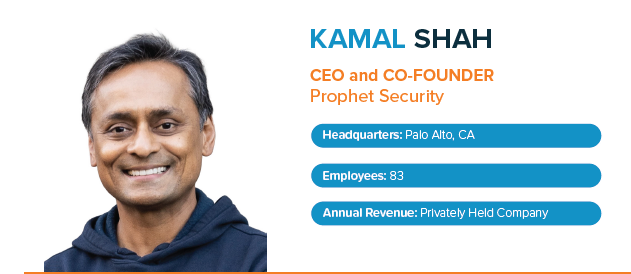
Kamal Shah’s interest in cybersecurity began in 2011 when one of his first startups was acquired by Symantec. After spending a year with Symantec, he joined Sequoia Capital as an entrepreneur in residence, where conversations with CIOs gave him an early view into the security challenges emerging as businesses moved more of their data to the cloud.
Those conversations led Kamal to join Skyhigh Networks as its eighth employee, helping scale the company before its acquisition by McAfee. He later became CEO of a container and Kubernetes security company that was acquired by Red Hat.
Across those experiences, Kamal continued to hear the same frustration from security teams: too many alerts and too many false positives. When generative AI began demonstrating what was possible, he saw an opportunity to approach a longstanding security operations challenge differently.
“The number one complaint I used to hear from our customers was too many alerts, too many false positives,” Kamal recalls. “I asked myself: could we leverage AI and agentic AI specifically to automate the process of triaging, investigating, and responding to alerts?”
That question became the foundation for Prophet Security.
Solving a Persistent Security Challenge
Before building the company, Kamal and his co-founders went directly to the security leaders experiencing the problem. They spoke with 78 CISOs and security leaders to understand whether existing SOAR technology had successfully addressed alert fatigue.
Only two of those 78 leaders said they were happy with their SOAR implementation. Many had automated only a small number of playbooks and found the process required significant engineering resources to maintain. For Kamal, it validated the need for a different approach.
Prophet Security was founded in September 2023 around the idea that agentic AI could take on more of the investigative work traditionally handled by security analysts. As competition in the market has grown, Kamal believes differentiation starts with something relatively simple: trust.
“Security has been pitched a lot of promises around machine learning and AI over the past several years,” he explains. “The approach we took from day one is: how do we make sure that we build trust with our customers every single day?”
For Prophet, that means prioritizing the accuracy of its investigations while giving security teams visibility into how the technology reaches its conclusions. The platform shows the questions it asks, the information it retrieves, and the evidence behind its reasoning. Kamal believes that transparency is essential for security teams being asked to place greater responsibility in the hands of AI.
Building a Platform for Security Operations
Prophet initially entered the market with its AI SOC Analyst, designed to support level one and level two security operations by investigating and responding to alerts. The company has since expanded its vision beyond the initial use case.
In December 2025, Prophet launched AI Threat Hunter, which allows security teams to conduct threat hunts using natural language while also proactively identifying emerging threats. More recently, the company introduced AI Detection Engineer, extending the platform into another critical part of security operations.
The idea for Detection Engineer came directly from a Fortune 50 financial services customer. The CISO raised a fundamental question: How could the organization prove it had the right detections in place across its attack surface?
Prophet built the product to help answer that question. AI Detection Engineer maps an organization’s detections and investigations to the MITRE ATT&CK framework, identifies potential coverage gaps, and helps teams create or improve detections. Early customer conversations have reinforced for Kamal how pressing that challenge has become.
“We are finding that in most cases, customers are missing detections, or they may have a detection in place, but it’s not firing,” Kamal explains. “Being able to surface those gaps has been eye opening for our customers.”
Together, the products reflect Prophet’s broader goal of building a platform that supports security operations across multiple roles rather than solving a single workflow. The company also offers a 24/7/365 human in the loop service for organizations that want the advantages of AI while maintaining human oversight around the clock.
Listening to the Customer
Customer feedback has played a significant role in how Prophet develops its technology. It began before the company was founded with the conversations Kamal and his co-founders had with those 78 security leaders and continues through the way the company works with customers today.
Each customer is assigned a customer success professional with previous security operations experience. Those conversations are used to understand desired outcomes and identify where the product needs to evolve. Prophet also reserves 20 percent of its engineering capacity for customer requests, with a goal of responding to those requests within 30 days.
That direct connection extends beyond the customer success team. Kamal wants product managers and engineers to speak directly with customers rather than relying on information to move through several layers before reaching the people actually building the technology.
“This is the age of AI. You can’t take the traditional approach of a customer communicating with a sales engineer, who then talks to a product manager, who then talks to an engineer,” he explains. “We want engineers involved in conversations with customers directly.”
For Kamal, that responsiveness is not only part of the customer experience. It influences how quickly Prophet can learn and continue developing its platform.
Building for the Age of AI
That same sense of urgency shapes how Kamal thinks about building the company itself. Prophet is growing quickly, and he does not believe the traditional approach to scaling a software company necessarily applies in an AI driven market.
Hiring starts with understanding the problems customers are trying to solve. In customer facing roles, Prophet looks for people with security operations experience who can understand those challenges firsthand. Kamal also values people who are willing to act quickly and remain open to changing how they work as the company evolves.
“The way you build a company in the age of AI is different than the way you have traditionally scaled companies,” Kamal comments. “You have to do things differently, otherwise you’re not going to scale.”
That philosophy extends to how Prophet takes its technology to market. The company is channel first, and sales conversations are always product focused. Rather than spending most of an initial meeting presenting slides, the team moves quickly into the product and demonstrates what it can do within a customer’s environment.
For Kamal, showing value is more effective than spending time explaining a problem security leaders already know they have.
Staying Close While Scaling
As CEO, one of Kamal’s challenges is maintaining the customer connection that helped shape Prophet, while building an organization that no longer depends on its founders for every conversation.
In the company’s earlier stages, Kamal and his co-founders regularly participated in multiple customer calls each day. As Prophet has grown, more of his attention has shifted toward enabling the broader team to carry those conversations forward. The company conducts training with its sales engineering team every two weeks to keep pace with new features and capabilities.
Kamal still makes a point of joining customer and prospect meetings himself. He believes staying connected to the market is particularly important when both technology and customer expectations are changing.
“The market’s moving very quickly, AI is moving very quickly, and we have to be on top of it to make sure that we are also moving quickly,” he explains.
That connection between listening and moving rapidly has been consistent throughout Kamal’s career. Today, customer feedback continues to influence where the company goes next. “We are just getting started,” he shares.
Subscribe
Stay up to date with cyber security trends and more